Monday, March 26, 2012

Garden Structures

Garden structures are a great way to add height interest to your landscape.  Arbors, pergolas, vine poles and trellises all have a purpose, but along with that purpose comes the prospect of a new way to add more beauty and color to your landscape. 

Arbors are synonomous with roses, but there are several other plants that can create an equally appealing look, depending on the style of your landscape and the style of the arbor you choose.  A simple arbor can create a welcoming entryway when placed over a walkway. 


A well-designed pergola can be used to create a new "room" for your home.  When placed on a deck or patio, with the right furniture and some exterior fabric your landscape instantly becomes additional living space. 


A garden trellis as a stucture will serve as support for any climbing plant or vine.  Additionally, if placed in a certain area of a landscape, it creates a wall for privacy or a blank canvas for adding color with flowering plants.  With a variety of shapes and construction materials, there's a trellis available to match any home.


A vine pole is one of the easiest ways to train a flower vine that needs support, particularly a very fast growing species. 


Thursday, March 22, 2012

Hey, Chickadee

Want to bring more birds to the yard?  There has to be a reason for them to want to be repeat visitors, and that reason usually surrounds food.   Why not spend a little time on a rainy day creating a homemade birder feeder?  We searched the web and decided to share our favorites, complete with links and instructions. 

This is a super cute, easy one that we found at Smile Monsters blog.


If you've got small children and are looking for a fun, easy activity then the bird feeder at Surviving Motherhood is a perfect choice.

A recycled soda bottle?  Yes!  Disney'st Family Fun shows you how a recycled bottle and some old wooden spoons make a creative, easy bird feeder.

This one might be my favorite.  Apartment Therapy shows us a cute way to recycle an old toy.  


Have you come up with any ideas for bird feeders?  We'd love to hear your thoughts.  Share your ideas here.


Tuesday, March 20, 2012

Bug Buddies

We always hear about the insects we don't want in our gardens.  You know the ones. Those pesky bugs that devour our flowers, shred the new leaves on our trees or damage our grass. Not all bugs are a nusiance.  In fact, some give our gardens huge benefits, acting as neatural pest controllers or pollinating our flowering plants.

These are the insects and bugs you should welcome to your garden:


Green Lacewings.  The larvae of this insect prey on aphids.  They are nicknamed "aphid lions," and the devour the pesky aphids at an amazing rate. 


Bees.  Bees polinate plants, propagating your flowers.


Assassin Bugs.  This bug feeds on everything from beetles to caterpillars.  Their name should give you a hint of what they're capable of in the bug world.  Be careful if you handle one. They do have a pretty painful bite. 


Dragonflies.  They prey on aphids and mosquitos.


Praying Mantis.  With a vorocious appetite, these green giants of the garden will go after any pest in your garden.  They are very effective in controlling garden pests. 


Ground Beetle.  Ground beetle larvae develop in the soil and prey on the pests found on the ground.  These include slugs, cutworms, snails and root maggots. 


Lady Bugs.  We like them because they are cute, but they are also the most commonly used bug to control pests.  They love aphids, but they also eat whitefly, scales, mites, mealybugs, tomato hornworms and cabbage moths.


Centipedes and Millipedes.  Centimpedes hunt soil pets including slugs and fly pupae.  Their burrowing also improves your soil. 


Monday, March 19, 2012

Taking the Outdoors Indoors

We often get asked, "What flowers should I plant for cutting? " and that's a question we love to answer. 

The choices are endless, but these are a few of our favorites:


Yarrow.  This is a tough, easy to grow perennial that blooms and blooms.


Star Gazer Lily.  It's pretty and it smells good.  Of course, we recommend it!


Coreopsis.  It's simple and has a down home, country feel.


Bearded Iris.  With a huge variety of colors, it's hard not to fall in love with these favorites.


Blazing Star.  Gorgeous stalks of color that are also great for drying.


Summer Phlox.  Old fashioned, full and fragrant.


Perennial Sage.  A vibrant purple-blue color.  The more you cut, the more blooms it produces.

Friday, March 16, 2012

Spring Bloomers

Who doesn't love March?  A good amount of this love comes around because of the beautiful blossoms appearing on so many trees in the Hampton Roads area.  Stunning is an understatement when trying to describe the visual that a large blooming tree offers.  We have a few favorites, and seeing these particular species in full bloom just screams "Spring is Here." 


Yoshino Cherry.  This is one of the largest of all flowering Cherry, with a habit that is more spreading than the usual vase shape. Broad canopy means it will provide shade for smaller patios, front yards, and other outdoor living spaces. A stunning single specimen in lawns or when used as a street tree. Even more lovely at your front-yard entry gate or to highlight a cottage garden. Large enough to line driveways or mark vehicle entries. Size makes it a great source of strong spring color in large home landscapes, parks and commercial sites.


Chinese Fringe.  This outstanding small tree will provide perfect interest for spatially challenged front yards. Wider than tall, it will also work well as filtered shade in outdoor living spaces that can afford to be overwhelmed by large trees. Set far back in the landscape against dark evergreen trees for a gorgeous bloom spectacle in sharp contrast. Show white blossoms become luminescent in the moonlight. Also works nicely as an accent tree surrounded by high profile perennials in the lawn.


Aurora Dogwood.  A spectacular accent tree for high profile front yards in the lawn or in beds with more diverse planting. Makes a stellar focal point in backyard landscape and it will draw the eye wherever it grows. Plant aligned with picture windows or sliding glass doors to better enjoy its seasonal changes from indoors. Good accent for shading and interest close to patio or terrace. Outstanding beneath a canopy of old shade trees or set into a woodland composition with understory species native or exotic. A valuable disease resistant replacement for dying Cornus florida and other susceptible dogwoods.


Eastern Redbud.  Redbuds offer four seasons of change in the front yard foundation planting for an eye catching display. A native of the eastern U.S. makes it a perfect candidate for wild gardens, wildlife gardens and all native landscapes. Add to beds and borders or to create long range focal point.


Alexander Magnolia.  A medium-sized flowering tree that is unmatched for elegant beauty and old-fashioned charm. Plant as a single specimen in the front yard or flank your entry walk with a matched pair. This is a darker Saucer Magnolia that produces better color for larger landscapes, where it stands out even at a distance. Such large softly colored blossoms make a great study near patios, porches and other outdoor living spaces. Can be planted as a small city street tree, but does not do well where pavement is salted in winter.


Chanticleer Flowering Pear.    Exquisite flowering tree displays a dazzling profusion of white flowers in early spring. Narrow, pyramidal form is coated with dark green summer foliage turning brilliant reddish-purple in fall. Ideal specimen tree for areas with limited space.


Thursday, March 15, 2012

Sensitivity

With proper design and planting, your garden can become a feast for the senses.  Sight.  Smell.  Taste.  Touch.  Hearing.  Plants can enhance your life in so many ways, and its important to entice each of your senses with your landscape.  Plant a Sensory Garden and please all your senses.

Sight


Balloon Flower.  Upright stems bear whimsical flower buds shaped like hot air balloons that open to large, blue flowers with purple veins.


Red Hot Poker.  With multiple varieties available, these plants produce spikes of upright, brightly-colored, red-to-orange flowers.


Jacob's Ladder.  This intriguing plant forms a tidy mound of brightly variegated green and white foliage. Lovely blue flowers make a striking combination with the foliage. Excellent for use as contrast or accent in perennial borders.


Giant Sunflower.  The sunflower got its name from its huge, fiery blooms, whose shape and image is often used to depict the sun.


Poppies.   Great addition to borders, containers, rock gardens and scattered throughout mixed beds.


Coneflower.   A well behaved, easy to grow native perennial that is favored by butterflies.


Smell


Lavender.  Fragrant, large, vibrant bluish-purple flowers complement the gray-green finely textured foliage. Ideal for borders, cottage gardens and containers.


Chocolate Cosmos.  Velvety textured, chocolate-scented, deep maroon flowers with darker brown center on divided dark green leaves.


Fino Verde Basil.  Attractive, small-leaved bush basil. Great in the garden and the kitchen: the taste is pure sweet basil; excellent in salads


Honey Perfume Rose.  Exhibits a great spicy scent and very good resistance to disease, including rust and powdery mildew.

Taste


Albion Strawberry.  This newer everbearing selection offers a superior robust flavor and rich red fruit color, with excellent disease resistance. The fruit is easily identified by its long, conical, and very symmetrical shape. Albion also produces an extremely high yield.


Swiss Chard.  While the leaves are always green, chard stalks vary in color.  Chard has been bred to have highly nutritious leaves at the expense of the root (which is not as nutritious as the leaves). Chard is, in fact, considered to be one of the healthiest vegetables available and a valuable addition to a healthy diet.


Variegated Lemon Thyme.  Colorful golden-edged green foliage is invaluable for adding color and contrast to patio containers, flowering borders and small open areas. Lemon-flavored foliage adds zest to marinades and more.


Flat Leaf Parsley.   Flat-leaved parsley is preferred by some as it easier to cultivate, being more tolerant of both rain and sunshine,  and has a stronger flavor.


Touch


Lamb's Ear.  Garden visitors will enjoy the soft feel of the foliage. Dense rosettes of thick, soft, velvety, silver-green leaves form a soft mat, making an excellent edging or low border.
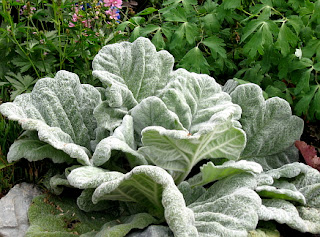


Silver Sage.  Silver sage is also known as silver clary or silver clary sage. Silver sage is grown for its striking white leaves. The leaves are wide with scalloped edges and are covered with downy hairs that give them a fuzzy appearance.


Bunny Ears Cactus.  New pads are red and appear in pairs, like the ears of a rabbit, and soon mature to dark green. Yellow flowers, easy care and unique architectural form make this valuable as a specimen, patio container or security barrier plant.


Scotch Broom.  Great hedge or low screen. Interesting to the touch, its long sprays of pea-like blooms make this a lovely spring accent. A wide, dense mound displays tiny bright green leaves. 


Jerusalem Sage.  Golden-yellow flowers appear in whorls among woolly, wrinkled leaves for a pleasing contrast. Cutting back faded flower stems promotes continuous bloom.


Hearing


Love in the Mist.  The plant's common name comes from the flower being nestled in a ring of multifid, lacy bracts. The fruit is a large and inflated capsule, growing from a compound ovary, and is composed of several united follicles, each containing numerous seeds. The capsule becomes brown in late summer, creating a rattle effect.


Canterbury Bell.  This beautiful flower will attract a multitude of buzzing bumblebees to your garden. 


Rattle Snake Grass.  One of the easiest and most dependable ornamental grasses to grow. Use as a single specimen or mass as a groundcover. Flowers can be cut for fresh or dry flower arrangements. It creates a whispering sound when it blows in the wind.